
Introduction
Geometry Learn V3 is an advanced interactive learning system designed to make geometry easier, more visual, and more practical for students and self-learners. Instead of focusing only on formulas and memorization, it emphasizes understanding shapes, angles, spatial relationships, and problem-solving through guided visual learning and interactive tools.
Modern educational sources describe Geometry Learn V3 as part of a new generation of math learning platforms that combine step-by-step explanations, dynamic diagrams, and real-time interaction. This makes it easier for learners to understand complex geometry concepts such as triangles, circles, transformations, and coordinate systems through hands-on exploration rather than passive reading.
The goal of this system is simple: help learners build strong conceptual clarity so they can understand not just what a formula is, but why it works and how it behaves in real situations.
What Geometry Learn V3 Actually Is
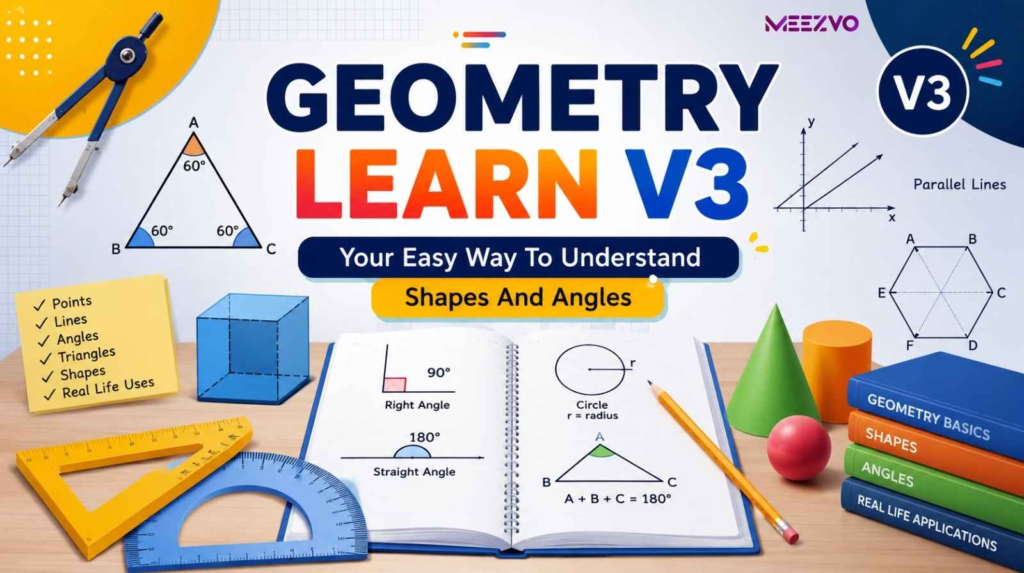
Geometry Learn V3 is an interactive digital learning approach that focuses on teaching geometry through visualization and guided practice. It allows learners to construct shapes, modify angles, and observe geometric relationships dynamically, which makes abstract ideas easier to understand.
Unlike traditional methods that rely heavily on textbooks, this system encourages learners to actively engage with geometry problems. Students can move points, reshape figures, and instantly see how changes affect measurements like angles, area, and symmetry.
In simple terms, Geometry Learn V3 turns geometry into an experience rather than a memorization task. Learners don’t just read geometry—they explore it.
Core Learning System and Step-by-Step Concept Building
One of the strongest parts of Geometry Learn V3 is its structured learning system. It introduces concepts in a gradual way so learners can build understanding step by step without confusion.
It usually begins with basic building blocks such as points, lines, and planes, then slowly progresses into angles, triangles, polygons, and circles. Each concept is connected logically to the next, which helps learners understand how geometry is built as a complete system.
Research-based educational descriptions highlight that this step-by-step method improves reasoning skills because learners understand both the process and logic behind each solution instead of simply memorizing answers.
Interactive Tools and Visual Learning Experience
Geometry Learn V3 is built around interactive visualization tools that allow learners to directly manipulate geometric shapes. Users can draw figures, measure angles, rotate objects, and observe real-time changes in structure.
This visual approach is extremely important because geometry is naturally a spatial subject. When learners can see how a triangle changes when one point moves or how a circle expands when radius increases, understanding becomes faster and deeper.
Studies on modern geometry learning approaches show that visual interaction improves comprehension because it strengthens spatial reasoning and helps learners connect abstract formulas with real-world behavior.
Key Geometry Topics Covered in Geometry Learn V3
Geometry Learn V3 covers a wide range of topics starting from beginner level to advanced geometry concepts. It begins with foundational ideas such as points, lines, and angles, which form the base of all geometry learning.
As learners progress, they explore triangles, quadrilaterals, circles, symmetry, and transformations. Each topic is supported with visual demonstrations that show how shapes behave under different conditions.
Advanced learning often includes coordinate geometry and spatial reasoning, where learners work with graphs, distances, and positions in a structured coordinate system, helping them connect algebra with geometry concepts.
Why Geometry Learn V3 Improves Understanding of Geometry
One of the main reasons Geometry Learn V3 is effective is because it replaces passive learning with active exploration. Instead of only reading formulas, learners interact with geometric models and observe how rules work in real time.
For example, when studying triangles, learners can adjust side lengths and immediately see how angles change. This hands-on experience builds stronger understanding compared to traditional memorization-based learning methods.
Educational discussions around this system suggest that learners develop better conceptual clarity because they see the direct relationship between shape, measurement, and transformation instead of learning them separately.
Real-World Applications of Geometry Learn V3 Concepts
Geometry Learn V3 is not only useful for academic learning but also helps learners understand real-world applications of geometry. Geometry plays a major role in architecture, engineering, design, mapping, and computer graphics.
For example, architects use geometric principles to design stable structures, while engineers rely on triangles for strength in bridges and buildings. Even digital animations and video games depend on coordinate geometry to create realistic movement and shapes.
By connecting geometry with real-life situations, learners understand why geometry is important beyond exams and how it influences modern technology and daily life.
Spatial Reasoning and Problem-Solving Development
A major benefit of Geometry Learn V3 is the development of spatial reasoning skills. Spatial reasoning is the ability to visualize objects in space and understand how they move or change.
Through interactive practice, learners begin to predict geometric outcomes, recognize patterns, and solve problems more efficiently. This improves not only mathematics skills but also logical thinking and analytical ability.
Over time, learners become more confident in solving geometry problems because they understand relationships between shapes instead of relying only on memorized formulas.
Benefits for Students, Teachers, and Self-Learners
Geometry Learn V3 is useful for different types of learners. Students benefit from simplified explanations and visual learning tools that make difficult topics easier to understand and remember.
Teachers can use it as a supportive teaching method to explain complex topics like proofs, transformations, and coordinate systems in a more engaging way inside classrooms.
Self-learners also benefit because they can study at their own pace, revisit difficult topics, and practice repeatedly until they fully understand the concept without pressure.
The Future of Geometry Learning Systems
Modern education is rapidly shifting toward interactive and visual learning systems. Geometry Learn V3 represents this transformation by combining structured lessons with real-time exploration and feedback-based learning.
Future learning systems are expected to become even more personalized, where learners receive guidance based on their performance and understanding level. This will make geometry even more accessible to learners of all backgrounds.
As technology continues to evolve, tools like Geometry Learn V3 will play an important role in making mathematics more engaging, practical, and easier to understand for future generations.
Conclusion
Geometry Learn V3 represents a modern shift in how geometry is taught and understood. Instead of focusing on memorization, it emphasizes visual learning, structured progression, and interactive exploration of geometric concepts.
By allowing learners to directly engage with shapes, angles, and spatial relationships, it creates a deeper and more practical understanding of geometry. It also connects classroom learning with real-world applications such as architecture, engineering, and digital design.
