
Introduction to 111.90.150.1888 and Why It Raises Questions
The keyword 111.90.150.1888 has gained attention online because it looks like a technical address, but at the same time appears unusual and confusing. Many users search for it trying to understand whether it is an IP address, a phone number, or something potentially risky. This confusion is common because the format resembles an internet protocol address, yet it does not follow standard rules.
In today’s digital world, numbers like 111.90.150.1888 often appear in logs, browser errors, suspicious links, or unknown online activities. When people encounter such numbers, they naturally want to know whether they are safe, legitimate, or associated with cybersecurity threats. Understanding what this number actually represents requires a clear explanation of how IP addresses work and why this specific format stands out.
Understanding IP Addresses and Standard Format
An IP address is a unique identifier assigned to devices connected to a network, allowing them to communicate with each other. These addresses are essential for internet communication, enabling data to travel between servers, computers, and mobile devices. Without IP addresses, the internet would not function as we know it.
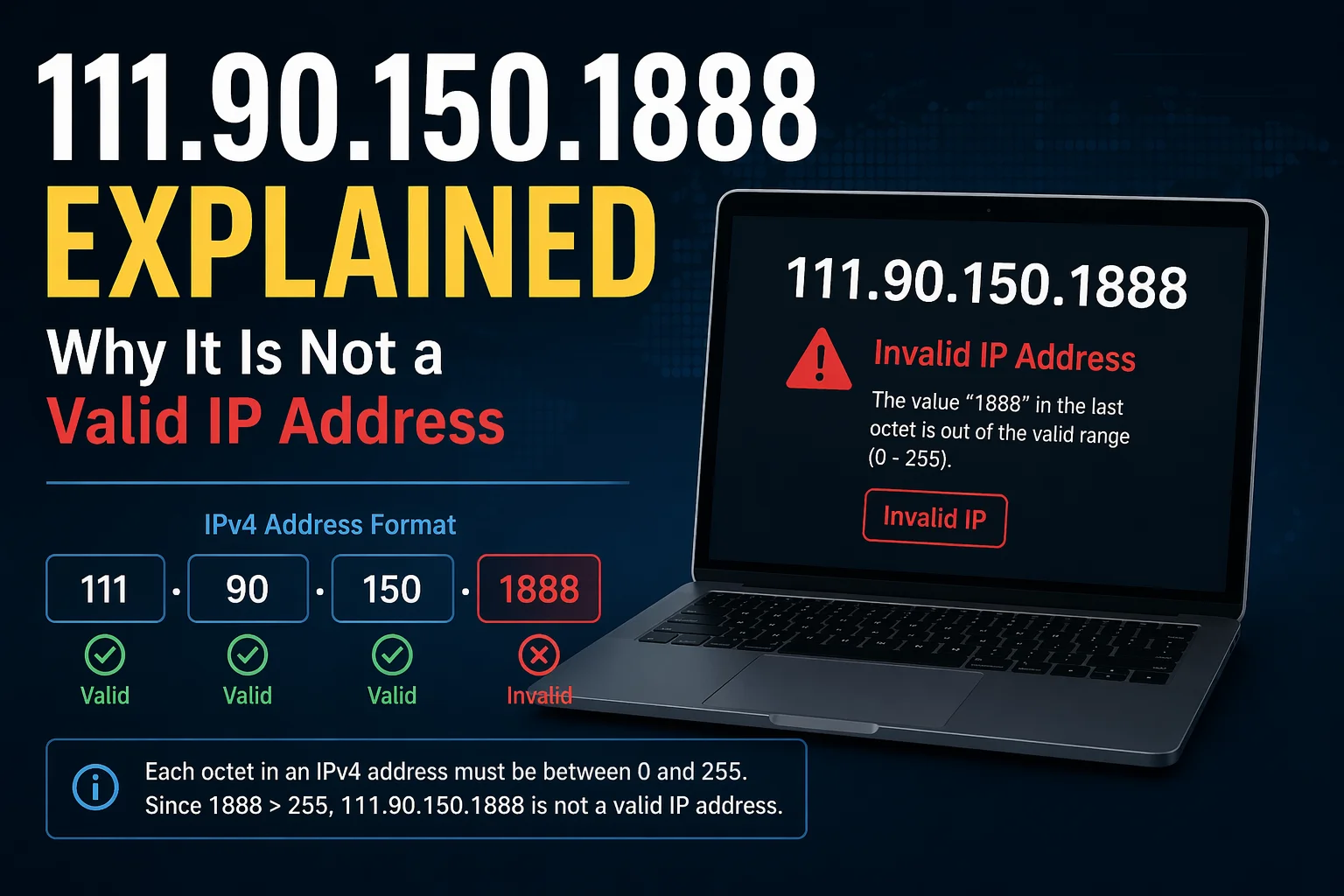
Standard IPv4 addresses follow a strict format consisting of four numerical segments separated by dots, such as 192.168.1.1. Each segment ranges from 0 to 255. This means a valid IP address always has exactly four parts. The number 111.90.150.1888 does not follow this structure because the last segment exceeds the allowed range, making it technically invalid as a standard IPv4 address.
Why 111.90.150.1888 Is Not a Valid IP Address
The number 111.90.150.1888 contains four segments, but the last segment “1888” is outside the acceptable range of 0 to 255. This alone makes it invalid under IPv4 standards. Valid IP addresses must strictly follow numerical limits to ensure proper routing and identification across networks.
Because of this invalid structure, 111.90.150.1888 cannot function as a real internet address. It cannot be used by servers, websites, or devices for communication. In most cases, such numbers appear due to formatting errors, intentional manipulation, or misunderstanding of how IP addresses work.
Possible Meanings Behind 111.90.150.1888
Although 111.90.150.1888 is not a valid IP address, it may still appear in different contexts. One possibility is that it is a malformed or incorrectly written IP address. For example, someone might have accidentally added extra digits while typing or copying a number.
Another possibility is that it is used as a placeholder or fake address in testing environments. Developers sometimes use unusual or invalid numbers to simulate data without connecting to real servers. In rare cases, such numbers may also appear in suspicious links designed to confuse users or bypass simple filters.
Connection to Private and Public IP Address Concepts
To better understand why 111.90.150.1888 is invalid, it helps to look at how real IP addresses are categorized. IP addresses are generally divided into public and private types. Private IP addresses are used within local networks and are not accessible from the internet.
These private addresses are assigned by routers and help devices communicate internally within homes or offices. They are not visible outside the network and cannot be used for direct internet communication.
Public IP addresses, on the other hand, are used to identify devices on the internet. Both private and public IPs must follow strict formatting rules, which further confirms that 111.90.150.1888 does not fit into any valid category.
Could 111.90.150.1888 Be a Security Risk
Even though 111.90.150.1888 is not a valid IP address, it can still be associated with potential risks depending on how it appears. If you encounter this number in suspicious emails, unknown links, or unusual system logs, it could indicate an attempt to mislead or confuse users.
Cybersecurity threats often rely on unusual or malformed data to bypass detection systems. While the number itself is not dangerous, the context in which it appears matters. For example, if it is part of a phishing attempt or a suspicious website link, it should be treated with caution.
Why Invalid IP Formats Appear Online
Invalid IP-like numbers such as 111.90.150.1888 can appear for several reasons. One common reason is human error, where a number is typed incorrectly or formatted improperly. Another reason is software bugs or logging errors, where systems record data in an unexpected format.
In some cases, attackers intentionally use invalid formats to evade detection. Security systems often rely on pattern recognition, and unusual formats may slip through filters. This is why it is important to verify any unfamiliar or suspicious number before interacting with it.
How to Handle Unknown Numbers Like 111.90.150.1888
When you encounter a number like 111.90.150.1888, the best approach is to avoid interacting with it until you understand its source. Do not click on links or trust any communication that includes unfamiliar or suspicious numbers.
If the number appears in system logs or network activity, it may be helpful to consult technical support or cybersecurity tools for further analysis. Keeping your devices updated and using security software can also reduce the risk of encountering harmful content.
Importance of Understanding IP Address Basics
Understanding how IP addresses work is essential in today’s digital environment. It helps users identify valid and invalid formats, recognize potential risks, and make informed decisions when dealing with unknown data.
IP addresses are fundamental to internet communication, but they must follow strict rules to function correctly. Learning these basics allows users to quickly spot anomalies like 111.90.150.1888 and avoid confusion or unnecessary concern.
Conclusion: Final Thoughts on 111.90.150.1888
The number 111.90.150.1888 may look like a technical address, but it is not a valid IP address due to its incorrect format. Its presence online is usually the result of errors, testing data, or potentially misleading content rather than legitimate network activity.
While the number itself is not inherently dangerous, it should be treated cautiously if it appears in suspicious contexts. Understanding IP address structures and basic networking concepts helps users stay informed and protected.
In conclusion, 111.90.150.1888 serves as a reminder that not everything that looks technical is valid. Staying aware, verifying information, and maintaining good digital habits are the best ways to navigate such situations safely.
